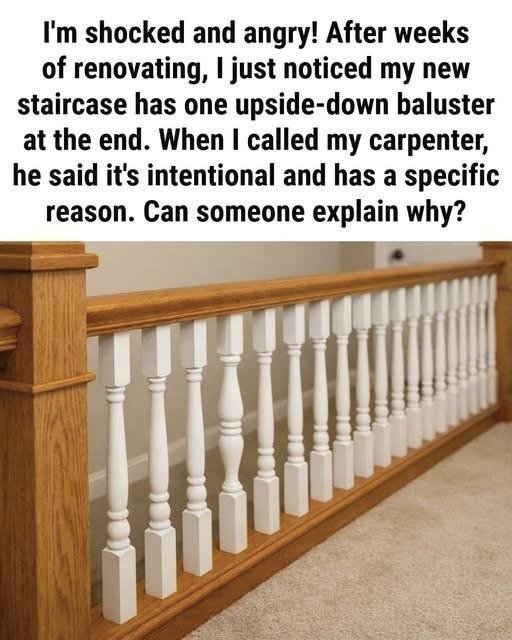
You’re running your hand along a staircase railing in an old home when you spot it: one baluster—perfectly crafted but unmistakably inverted among its upright neighbors. Your first thought? “A builder’s mistake.” But then you hear whispers of a deeper meaning: a centuries-old tradition of humility, where craftsmen deliberately introduced flaws to honor divine perfection.
It’s a beautiful story—one that’s captivated homeowners, tour guides, and social media for years. But is it true? Let’s explore the history, separate fact from folklore, and honor the real legacy of craftsmanship.
 The Allure of the “Intentional Imperfection” Myth
The tale goes like this:
Only God is perfect. To create something flawless would be prideful. So craftsmen added a subtle flaw—a reversed baluster, a misplaced tile—to acknowledge human limitation.
This narrative appears across cultures:
Islamic architecture: Deliberate asymmetry in geometric patterns
Navajo weaving: The “spirit line” allowing the weaver’s soul to escape
Japanese kintsugi: Gold-repaired cracks celebrating brokenness
Amish quilts: A “humility block” sewn askew
These traditions are real and well-documented. But does the upside-down baluster belong to this lineage?
 The Historical Reality: No Evidence of Intentional Inversion
Despite its popularity, there is no historical evidence that stair builders deliberately installed upside-down balusters as a spiritual practice. Here’s why:
Claim
Reality Check
“Craftsmen added flaws to avoid hubris”
 No period documents, guild records, or builder memoirs mention this practice for staircases
“It’s found in historic homes worldwide”
 Rarely documented in architectural surveys—most “discoveries” are anecdotal
“It confuses evil spirits”
Folklore with no basis in carpentry traditions—unlike spirit lines in weaving (which are documented)
 Key insight: Stair balusters are symmetrical by design. Many profiles (like turned spindles) look identical right-side-up or inverted. What appears “upside-down” may simply be consistent orientation based on how the craftsman grabbed them from the pile.
 Why Balusters Actually Get Installed “Upside-Down”
Cause
Explanation
Symmetry illusion
Turned balusters often have identical top/bottom profiles—orientation is arbitrary
Production efficiency
Carpenters install spindles quickly; flipping one saves seconds during assembly
Replacement error
A damaged baluster replaced by a homeowner who didn’t notice the original orientation
Design choice
Some styles (like barley-twist) intentionally alternate directions for visual rhythm
 Architectural note: In true historic craftsmanship (1700s–1800s), balusters were custom-turned to fit specific stair angles—making random inversion unlikely. Mass-produced balusters (post-1900) lack this precision.
 When It Might Be Intentional (Rare Exceptions)